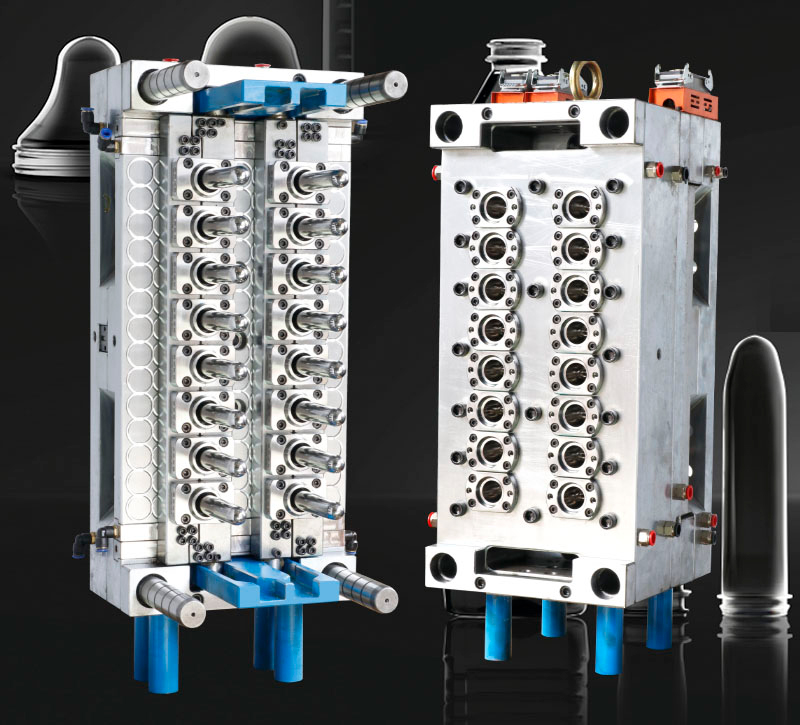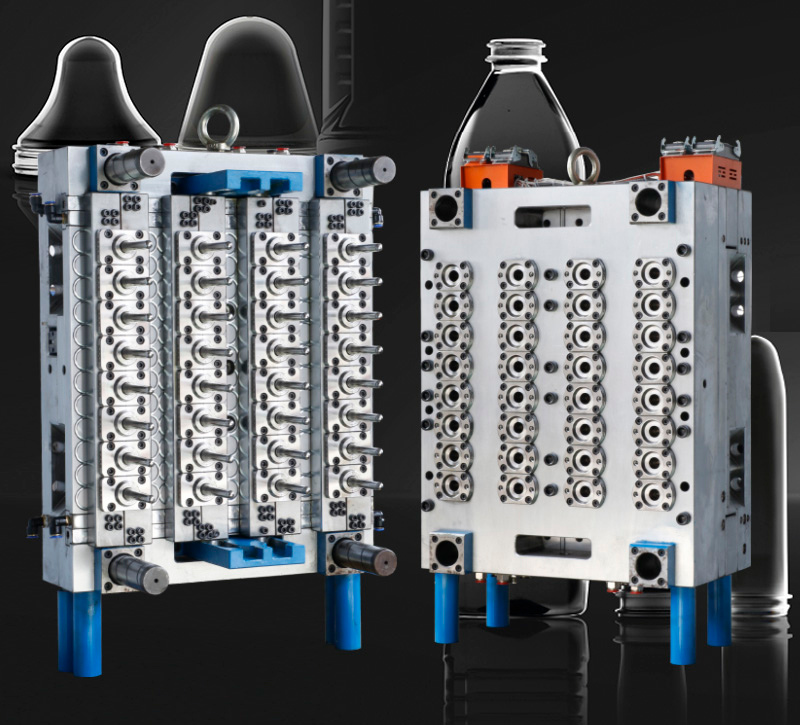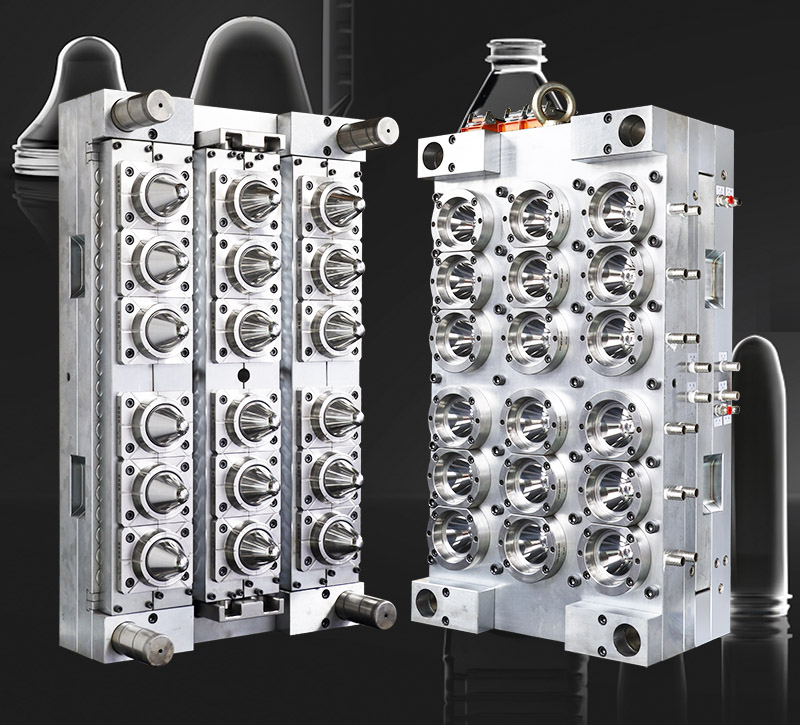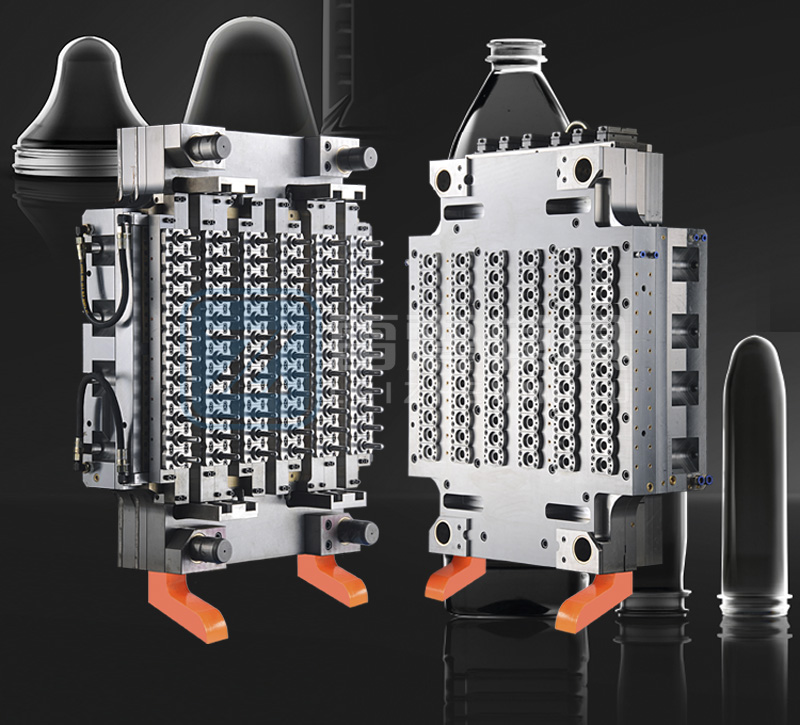
5 Questions You Must Ask Before Buying a PET Preform Mold (A Buyer’s Guide for Bottle Manufacturers)
Introduction: The Real Cost of a “Cheap” Mold
A PET preform mold costs between 80,000+ depending on cavity count. But the lowest quote often leads to:
Higher reject rates (2–5% vs. <1%)
Shorter mold life (under 1M cycles instead of 2M+)
Weeks of unplanned downtime
Talking to a mold supplier can feel like a technical exam. To help you ask the right questions—not just polite ones—here are 5 non-negotiable questions, why each matters, and what a good answer sounds like.
Question 1: What Steel Grade and Hardness Do You Use for the Cavities and Cores?
Why this matters: Steel determines wear resistance, cycle life, and final part quality. Many low-cost suppliers use P20 (HRC 30-38) which starts losing tolerance after 800k cycles.
What a good answer includes:
Specific grade (e.g., H13, 1.2344, or similar hot-work steel)
Hardness range (e.g., HRC 50-56, nitrided)
Whether the steel is pre-hardened (reduces distortion risk)
Red flags: “Tool steel” without a grade / “Hard enough” / Unwilling to provide test certification
LEIZHEN’s answer: We use H13 (1.2344), pre-hardened to HRC 52-56 via vacuum nitriding. Every batch comes with a hardness test report.
Question 2: What Is the Guaranteed Mold Cycle Life and Tolerance?
Why this matters: A mold that fails at 800k cycles forces you to buy a replacement 14 months earlier than a 2M-cycle mold. Tolerance directly affects preform neck sealing and wall uniformity.
What a good answer includes:
A guaranteed minimum cycles (e.g., 2 million shots)
A tolerance number for critical dimensions (e.g., ±0.01mm on sealing surface)
Whether the guarantee covers normal wear vs. damage
Red flags: “It depends on your maintenance” (without providing baseline) / No tolerance figure / “Lifetime warranty” (vague and often excludes wear parts)
LEIZHEN’s answer: We guarantee 2 million+ cycles with ±0.01mm tolerance on sealing diameter. At 2M cycles, wear is typically under 0.015mm—still within many customers’ spec.
Question 3: Can You Provide Cooling Flow Simulation Data – Not Just a Drawing?
Why this matters: Poor cooling extends cycle time (less output) and creates uneven preform temperatures (higher rejects). Many suppliers draw cooling channels but never simulate flow.
What a good answer includes:
A cooling simulation (or at least flow rate and pressure drop calculation)
Channel diameter, distance from cavity surface, and turbulence indication (Reynolds number > 4000)
Expected cycle time for your preform weight
Red flags: “We design cooling as per standard practice” / No numbers provided / Can’t explain how cooling affects crystallinity
LEIZHEN’s answer: We run Moldflow cooling analysis for every mold. We’ll show you the predicted temperature variance (we target <5°C across all cavities) and recommend water flow rate (e.g., 12 L/min per circuit).
Question 4: What Is Your Hot Runner System – Brand, Nozzle Type, and Support Arrangement?
Why this matters: The hot runner is the “heart” of a PET preform mold. Cheap no-brand systems cause gate drool, uneven filling, and color change delays. When a nozzle fails, you need spare parts quickly.
What a good answer includes:
Hot runner brand (e.g., Husky, Yudo, Mold-Masters, or a reputable Asian brand with local support)
Nozzle type: open vs. valve gate (for PET preforms, valve gate is standard)
Spare parts availability (stocked in your region? lead time for a new nozzle?)
Red flags: “Our own design” (without established track record) / “No problem, very reliable” but no brand name / “We can ship spare parts in 30 days” (too long)
LEIZHEN’s answer: We partner with Yudo (South Korea) and Synventive for hot runners. Valve gate nozzles. For major markets (North America, Europe, SE Asia), we keep a stock of common tips and heaters. Normal spare parts ship within 5 working days.
Question 5: What Post‑Delivery Support Do You Offer – Installation, Trial, and Troubleshooting?
Why this matters: Even a well-made mold may need adjustments when running on your specific press with your PET resin. A supplier who disappears after shipment leaves you to solve leaking nozzles, venting issues, or ejector pin marks alone.
What a good answer includes:
Remote support: Video call response time (e.g., within 24 hours)
On-site commissioning: Is an engineer available? Cost and response time?
Spare parts list delivered with the mold (heaters, thermocouples, ejector pins, etc.)
Documentation: PDF manual, recommended maintenance schedule, wear limit drawings
Red flags: “The mold should run fine” / “Our agent will help” (without naming the agent) / No documented maintenance schedule
LEIZHEN’s answer: Every mold ships with a 15‑page maintenance manual, a full spare parts list, and a calibration certificate. We provide remote video support within 24 hours (same day for urgent issues). On-site commissioning available in most countries within 10 days.
Supplier Scorecard: Compare Quotes Objectively
Print this table and fill it for each supplier (including us).
| Question | Supplier A | Supplier B | LEIZHEN (for reference) |
|---|---|---|---|
| Steel grade & hardness | ___ | ___ | H13 / HRC 52-56 |
| Guaranteed cycles (million) | ___ | ___ | 2M+ |
| Guaranteed tolerance (±mm) | ___ | ___ | ±0.01 |
| Cooling simulation provided? | ☐ Yes / ☐ No | ☐ Yes / ☐ No | Yes (Moldflow) |
| Hot runner brand | ___ | ___ | Yudo / Synventive |
| Spare parts lead time (days) | ___ | ___ | 5 days (common parts) |
| Remote support (hours) | ___ | ___ | 24h / same day urgent |
| On-site commissioning offered? | ☐ Yes / ☐ No | ☐ Yes / ☐ No | Yes |
Final Advice: One Small Test Before the Big Order
If a supplier passes these 5 questions, order one cavity set (or a small 8‑cavity mold) first. Run it on your press for 2–3 months. That test will reveal:
Actual cooling efficiency (cycle time)
Wear resistance (measure after 200k shots)
Support responsiveness
Only then scale to 48, 72, or 144 cavities.
Recent Posts